
Client Alerts
Levered Feeder Funds: Structural and Security Considerations in Fund Finance
August 24, 2026
By Leon Stephensonand Jennifer Passagne
Master fund-feeder fund structures are increasingly being combined with financing arrangements at both the feeder fund and master fund levels. While this provides useful liquidity for investors and flexibility for managers, it closely links two otherwise separate credit facilities.
In practice, both lenders may ultimately rely on the same underlying investor commitments. This overlap requires careful management around security, treatment of capital calls and control of cash, particularly when a feeder’s commitment to the master fund is included in the master fund lender’s borrowing base.
To ensure a successful structure, financing arrangements must operate together without creating uncertainty over competing rights. The parties should agree in advance how investor commitments and capital-call proceeds will be controlled, which lender has priority in relevant circumstances, what happens following a default and whether one lender can take action that could prejudice the other.
Thoroughly reviewing fund documentation and aligning both sets of finance documents are essential steps. By clearly mapping the flow of funds and layering rights, lenders and sponsors can establish a predictable framework that preserves the intended commercial position during enforcement or financial distress.
Introduction
Master fund-feeder fund structures are a familiar feature of private investment funds, allowing investors with different tax, regulatory, jurisdictional or investment requirements to participate in a common investment programme through one or more feeder fund vehicles. The financing of those structures has also become increasingly sophisticated. In particular, a lender may provide financing directly to a feeder fund, while the master fund simultaneously maintains a conventional subscription line facility.
This creates a two-tier financing structure in which both lenders may ultimately rely on the same pool of investor-funded liquidity. The feeder fund lender relies principally on the feeder’s investment into the master fund and possibly the feeder’s investor commitments, while the master fund lender may include the feeder’s commitment in its borrowing base.
The key questions are therefore not simply whether the feeder fund can borrow and grant security. Instead, parties must address:
- Collateral Mapping: What specific assets does each lender hold as collateral?
- Security Interaction: How do the two security packages impact each other?
- Cash Flow Control: Who directs the incoming money?
- Default Protocols: What happens if either loan goes into default?
The Basic Structure
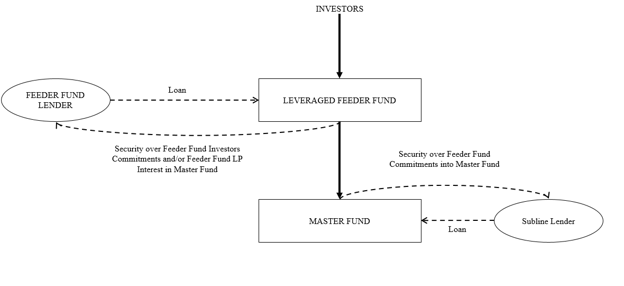
The feeder fund makes a capital commitment to the master fund. When the master fund makes a capital call to the feeder fund, it will use a combination of its own cash and borrowings under its feeder fund facility.
At the master fund level, the subscription line lender would normally include the feeder’s unfunded commitment in the master fund’s borrowing base. Therefore, the master fund lender relies on the feeder’s contractual obligation to fund the master fund, while the feeder fund relies on the feeder’s investors and the feeder fund lender to provide the cash required to meet that obligation. The two facilities are legally distinct but economically interconnected.
The Feeder Fund Lender’s Collateral Package
To secure its position, a feeder fund lender typically seeks a hybrid security package. Depending on the commercial deal, this collateral generally falls into two categories:
- Asset-Level Security (NAV Approach): The feeder fund lender may take security over the feeder’s limited partner (LP) interest in the master fund. This looks downward at the value of the master fund’s underlying portfolio. In addition, the feeder fund lender may take security over the account of the feeder fund into which distributions from the master fund are paid.
- Investor-Level Security (Subscription Approach): The feeder fund lender may also wish to have recourse to the undrawn investor commitments in the feeder fund and the specific bank accounts into which those capital calls are paid.
The exact makeup of this package depends heavily on two variables: the institutional profile of the investors in the feeder fund, and whether the master fund lender requires exclusive recourse to those same underlying commitments.
The Master Fund’s Subscription Facility
The master fund may have its own subscription line, secured by the unfunded commitments of its investors. Where the feeder fund is an investor in the master, the master fund will typically want the feeder’s unfunded commitment to be available as part of the master fund borrowing base.
This can result in two levels of financing where the same ultimate investor pool supports debt at two levels.
For example, assume:
- The feeder fund has €100 million of unfunded commitments from its investors;
- The feeder fund has committed €100 million to the master fund;
- The master fund includes that €100 million commitment in its subscription borrowing base; and
- The feeder fund has a €60 million facility from its own lender.
A master fund-level capital call does not automatically give the master fund lender a direct claim against the feeder’s investors. The master fund lender’s contractual claim is generally against the feeder fund, which must call its investors to obtain the necessary funds. However, most subscription line lenders would want the feeder fund to also guarantee the master fund’s borrowings if the feeder fund investor is to be included in the master fund borrowing base. This can result in two different lenders having a debt claim against the feeder fund.
This setup also exposes the fund to borrowing base asymmetry, which occurs when the master fund and feeder fund lenders inconsistently assess the same underlying investor’s creditworthiness. This mismatch — where a feeder fund lender restricts or downgrades an investor who is otherwise fully included in the master fund facility — creates immediate liquidity squeezes and cash traps for fund managers. To prevent these funding gaps, sponsors must align investor eligibility criteria and concentration limits across both facilities during documentation.
The Key Structural Issue and Interaction Between the Two Security Packages
The most important structural question for a feeder fund lender is whether the feeder fund can both borrow money to fund its commitment to the master fund, and grant security over the assets needed to make that commitment.
The feeder’s principal assets and liabilities are closely connected:
- Its investors owe capital to the feeder fund;
- The feeder fund owes capital to the master fund;
- The master fund may owe repayment obligations to its subscription lender; and
- The feeder fund owes repayment obligations to its own lender.
The relevant chain is:
Feeder fund investors → feeder fund → master fund → master fund lender.
A typical draw might operate as follows:
Step 1: The master fund lender advances €20 million to the master fund.
Step 2: The master fund makes a €20 million capital call on the feeder fund.
Step 3: The feeder fund draws €20 million under its feeder fund facility.
Step 4: The feeder fund transfers the €20 million to the master fund.
Step 5: The master fund uses the proceeds to repay the master subscription facility or otherwise applies them in accordance with its financing documents.
Alternatively, the master fund may call capital from the feeder fund without having first drawn under its subscription facility. In that case, the feeder’s borrowing may provide the ultimate source of cash for the master fund investment or expense.
The documentation should therefore clearly address priority over investor capital, control of capital calls and collection accounts, application of capital-call proceeds, the master fund lender’s ability to require funding following a feeder fund default, and the consequences of simultaneous defaults.
The parties should address expressly:
- Which lender has priority over investor capital;
- Which lender controls capital calls following a default;
- Whether one lender may block or restrict calls by the other;
- Whether proceeds of capital calls must be paid into a controlled account;
- Whether the feeder fund lender may apply investor proceeds directly to its debt;
- Whether the master fund lender can require the feeder fund to fund a master fund capital call notwithstanding a feeder fund-level default; and
- What happens if both facilities are in default simultaneously.
These are effectively intercreditor issues even if the transaction is structured so the lenders do not share identical collateral.
Payment Subordination Versus Priority of Security
It is useful to distinguish priority of security from payment priority. Security priority determines who has the first right to realise a particular asset. Payment priority determines who gets paid first from available cash.
Suppose the feeder fund lender has a first-priority security interest over the feeder’s investor commitments and related account. The master fund lender may nevertheless have contractual rights designed to ensure that the feeder fund continues to fund its master fund commitment.
The master fund lender may therefore seek protections such as:
- Restrictions on the feeder’s ability to amend its investor documentation;
- Minimum unfunded commitment requirements;
- Limits on withdrawals from the feeder fund collection account;
- Requirements that capital calls necessary to satisfy the master fund commitment be honoured;
- Turnover arrangements following an enforcement event; and
- Direct notice or acknowledgement arrangements with the feeder fund lender.
Conversely, the feeder fund lender will want comfort that its collateral cannot effectively be subordinated to the master fund lender through the master fund’s exercise of its capital-call rights. The distinction is particularly important in a levered feeder fund because the economic value of the collateral depends on the interaction between the two tiers.
Investor Documentation and Enforceability
The quality of the collateral ultimately depends upon the enforceability of the investor commitments. Both lenders should review the feeder’s limited partnership agreement (LPA), subscription agreements, side letters and other arrangements affecting capital calls.
For a levered feeder fund, where the lender has recourse over the feeder’s investment in the master fund, the feeder fund lender should also conduct due diligence on the master fund documents to ensure that there are no restrictions on the feeder fund (or feeder fund lender if it has been enforced) transferring its investment in the master fund. The feeder fund lender will also want to understand what other provisions in the master fund documents could impact it, such as defaulting investor provision, overcall rights of the general partner (GP) and the borrowing limits of the master fund.
In addition, sponsors must consider these dual-tier structures against the backdrop of prevailing ILPA guidelines, which may call for investor disclosures and LPAC approvals.
Structural Protections for the Feeder Fund Lender
From the feeder fund lender’s perspective, several protections are particularly important. First, the lender should have robust security over the feeder’s investor commitments and collection accounts.
Second, the lender should consider taking security over the feeder’s rights to receive distributions from the master fund.
Third, the facility should restrict the feeder fund from:
- Increasing its commitment to the master fund;
- Incurring additional debt;
- Granting competing security;
- Transferring its master fund interest;
- Amending investor documentation in a manner adverse to the lender; and
- Making distributions while specified debt or coverage conditions are unsatisfied.
Fourth, the lender should obtain sufficient information and consent rights over amendments to the master fund arrangements that could adversely affect the feeder’s ability to repay its debt, as well as information rights with respect to the master fund facility. If the feeder fund lender wants further protection, it may also request that its facility cross defaults if there is a default under the master fund facility.
Structural Protections for the Master Fund Lender
The master fund lender’s concern is different. Its principal objective is to ensure that the feederfund remains a reliable source of capital to the master fund.
Accordingly, the master fund lender may seek:
- Confirmation that the feeder’s financing is permitted under its constitutional documents;
- Minimum unfunded commitments at the feeder fund level;
- Restrictions on the feeder’s ability to incur excessive debt;
- Notice of feeder-level defaults;
- Limits on enforcement by the feeder fund lender;
- Rights to cure certain feeder fund defaults;
- Arrangements governing the use of feeder fund capital-call proceeds; and
- Acknowledgement from the feeder fund lender concerning the master’s rights following specified defaults.
Documentation Architecture
A well-structured transaction will generally require the financing documents at the two levels to work together.
The financing documents should recognise the existence of the two facilities and establish appropriate eligibility, covenant, security and enforcement requirements.
Depending on the structure, documentation may include:
- A feeder fund facility agreement;
- A feeder fund security agreement;
- Account control or account pledge/charge documentation;
- An intercreditor or coordination agreement if both lenders are seeking recourse from the same borrower and/or to the same security package;
- Acknowledgements from the master fund or its lender;
- Amendments or consents to the master fund LPA;
- Amendments or consents to the feeder fund LPA; and
- Notices or acknowledgements relating to investor capital-call rights.
The objective is to map the cash and collateral flows through the structure and establish precisely what each lender can and cannot do.
Conclusion
As more investors seek their own liquidity for their drawdowns, the levered feeder fund structure will continue to grow in popularity. If structured carefully, it is entirely possible to provide separate facilities to both feeder fund and master funds within a single fund structure. However, although the two facilities are legally distinct, their repayment sources remain tightly connected. The central structuring principle is therefore to preserve the separateness of the two credit relationships while expressly addressing their points of intersection.
The most important issues that must be negotiated are the scope and priority of security over capital-call rights, control of collection accounts, the treatment of the feeder’s commitment in the master fund borrowing base, enforcement restrictions and the consequences of default at either or both levels. The strongest structures begin by mapping the capital flows, which allows the parties to determine exactly who has rights over each contractual claim, account and payment stream.
Ultimately, the goal is not merely to give each lender a baseline level of security, but to ensure that when capital is called, the documentation produces a predictable and commercially agreed result.
Contributors


Practice Areas
For More Information